

Inventory and Remember
The stories behind our place settings

It’s the Monday before Thanksgiving, when last minute grocery lists are being scribbled, cloth napkins are being laundered, and we dig out the big casserole dishes from the high shelves of the pantry. For some households, this is the time to polish your mother’s silver and dust off the family china. Others of us have given up that tradition or never had such occasions and fancy adornments. Some of us might eat Thanksgiving out. Some of us don’t have much to eat at all and need help or an invitation. Regardless of our circumstances, humans want to collect and keep things that have meaning and hold memories for us. Holidays are a call to inventory and remember.
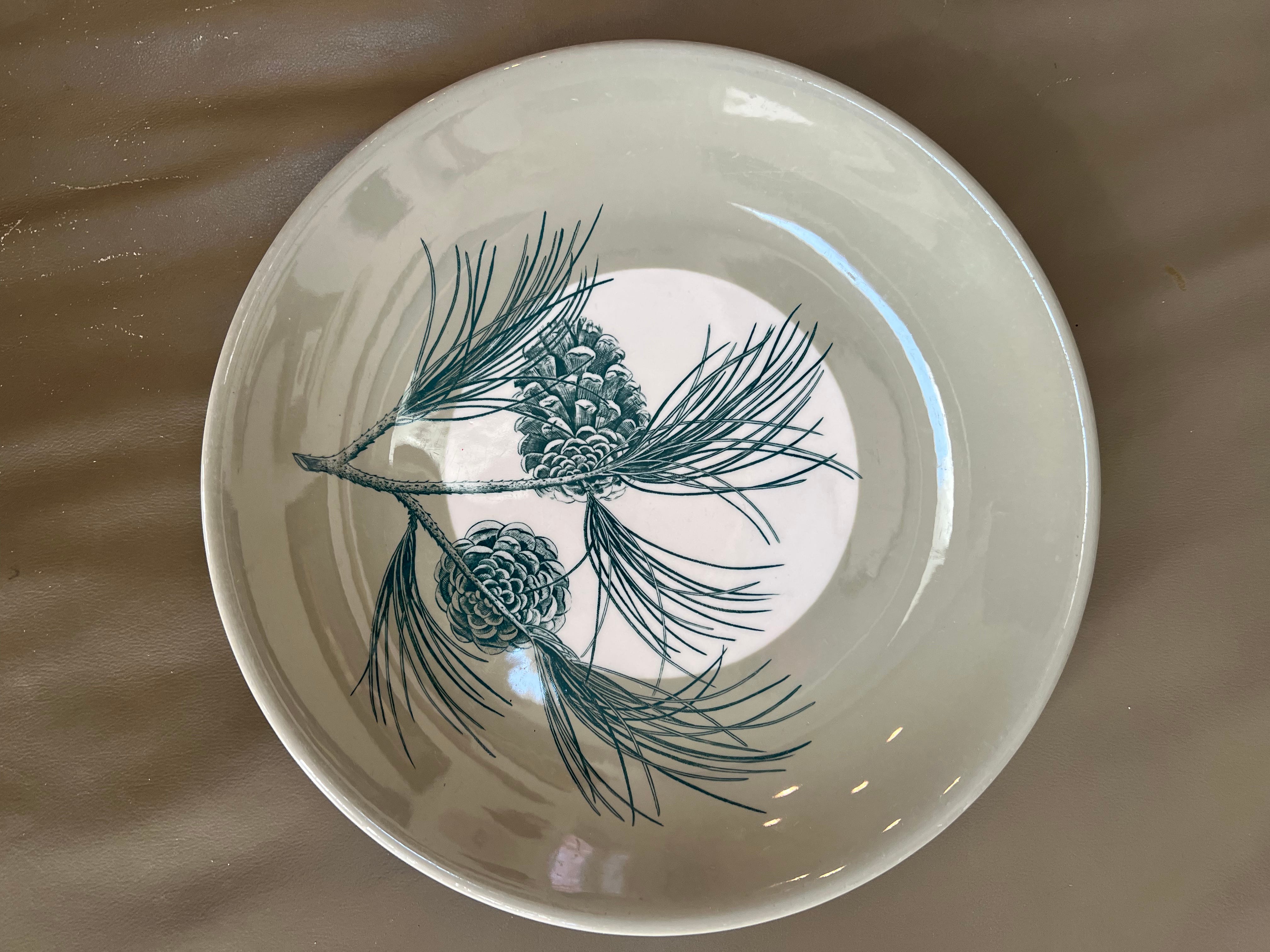
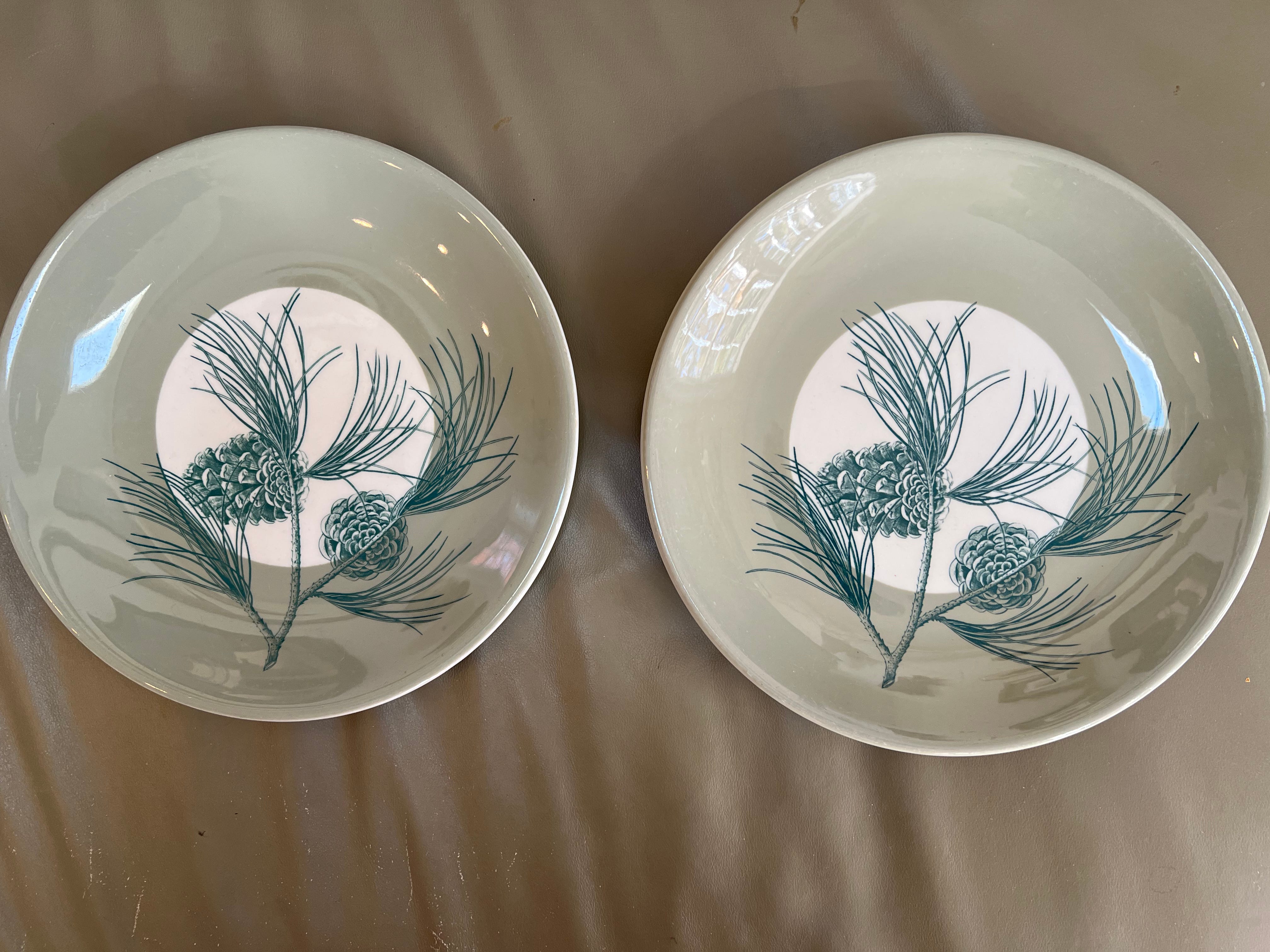
Edible memories are usually our subject here in Food Pilgrim, but I just ordered a couple of vintage plates on eBay with a painted pattern called “Carolina Moon,” and these plates got me to thinking about all the stories behind our place settings.
I am no expert when it comes to china patterns. Here in the North Carolina Piedmont, however, we have an enterprise called “Replacements.” If you’ve never been there, it is an enormous tableware museum with changing displays and a warehouse they say is comparable to eight football fields or a half million square feet that is home to 11 million pieces of inventory. The goods are stacked several stories high in fragile towers of plates, cups, bowls and gravy boats, along with crystal, silver and other collectibles. Replacements is a tangible testament to the tsunami of material culture that we humans, particularly in this region, have accumulated, celebrated, acquired and disposed of across our lives.
Now, I never bought a ticket on the bridal train. Never picked a pattern. Never filled out a registry. That stuff didn’t matter to me. Or at least that’s how I have thought of myself. But I am taking stock today after seven decades of collecting.
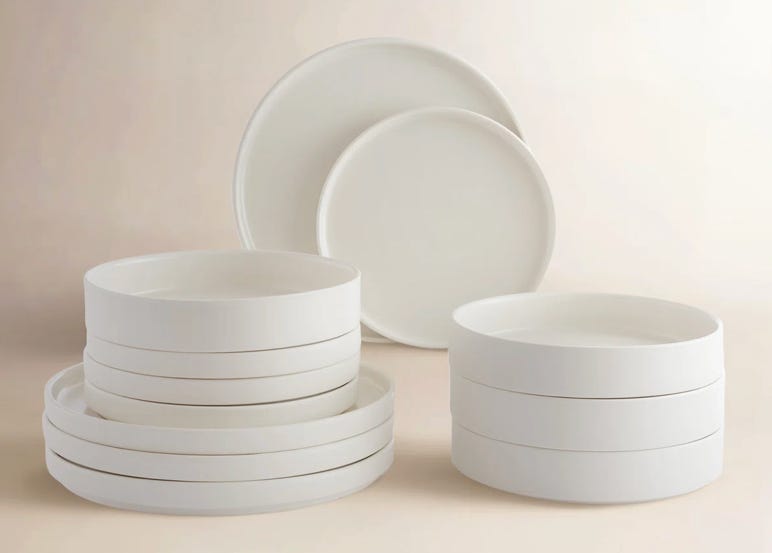
There’s the first set of pure white but hefty Bauhaus-style dishes that I bought with my employee discount right after college at dear old Morgan Imports in Durham. I was seduced by the saucers that could double as lids for the cereal bowls. The coffee cups also nested beautifully in stacks, as if designed by an architect. And yes, I still have them on the top shelf of the kitchen in our Blue Ridge cabin.
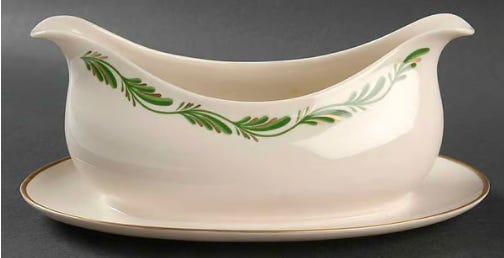
I also still have my mother’s wedding china and silver. It’s stored high above the fridge in Carrboro, and though it’s almost never used, I appreciate her good taste in choosing something understated, never gaudy, a pattern called Franciscan Arcadia in green and gold.
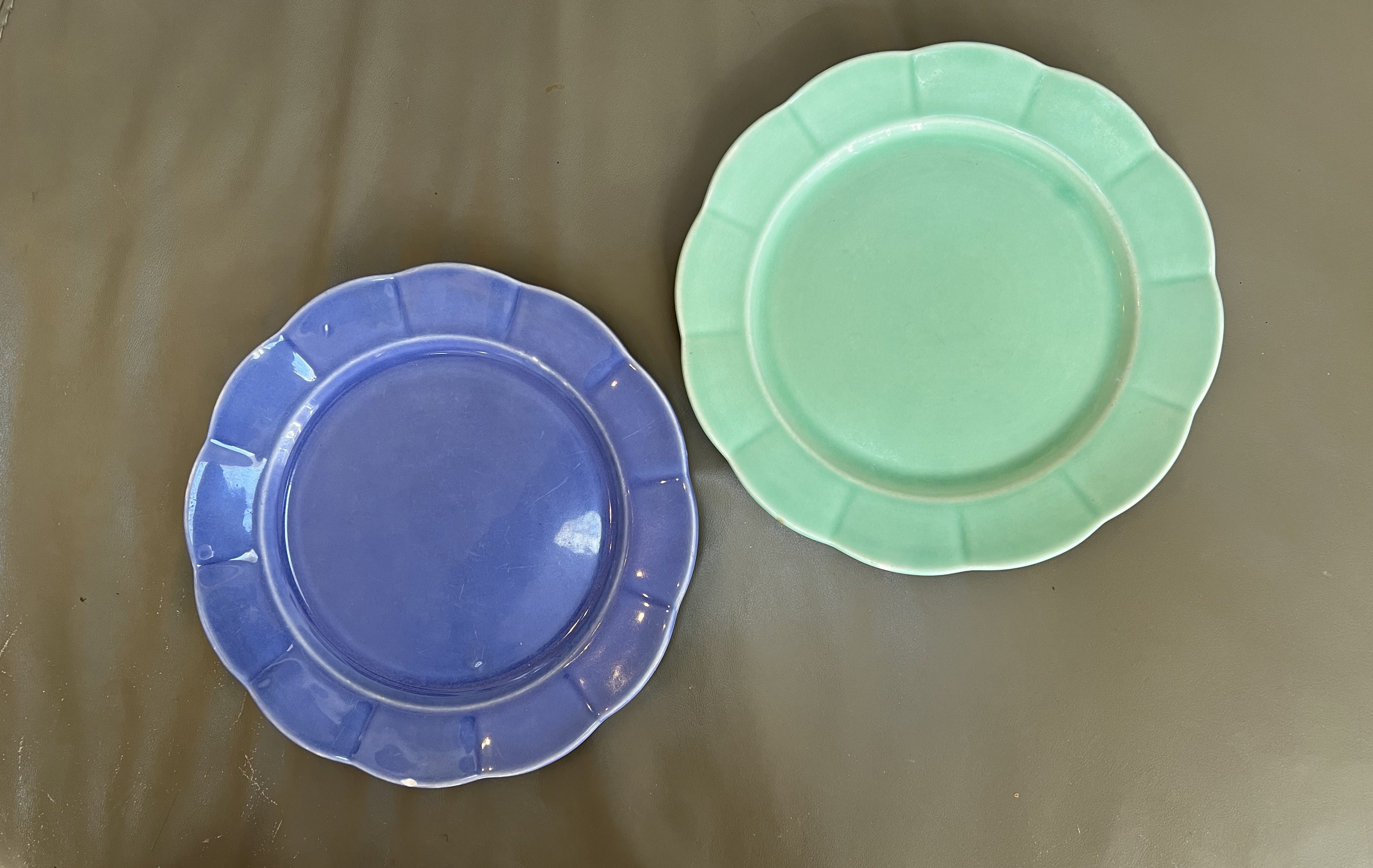
For breakfasts here I use my grandmother’s “everyday” plates in turquoise and seafoam, “Made in the USA by W.S. George, 1948.” Stella would set them out on the white, formica-topped table in her kitchen to receive a hearty breakfast. At supper she piled them with steaming vegetables and a slice of cornbread just out of the oven.
Early on in my career, I did some work for the brilliant sisters who built a hugely successful business importing the Italian dinnerware they call Vietri. I earned a few colorful dinner plates in trade for my writing services—several, alas, are now chipped—but they reveal the beautiful adobe color of the clay from which they are made.
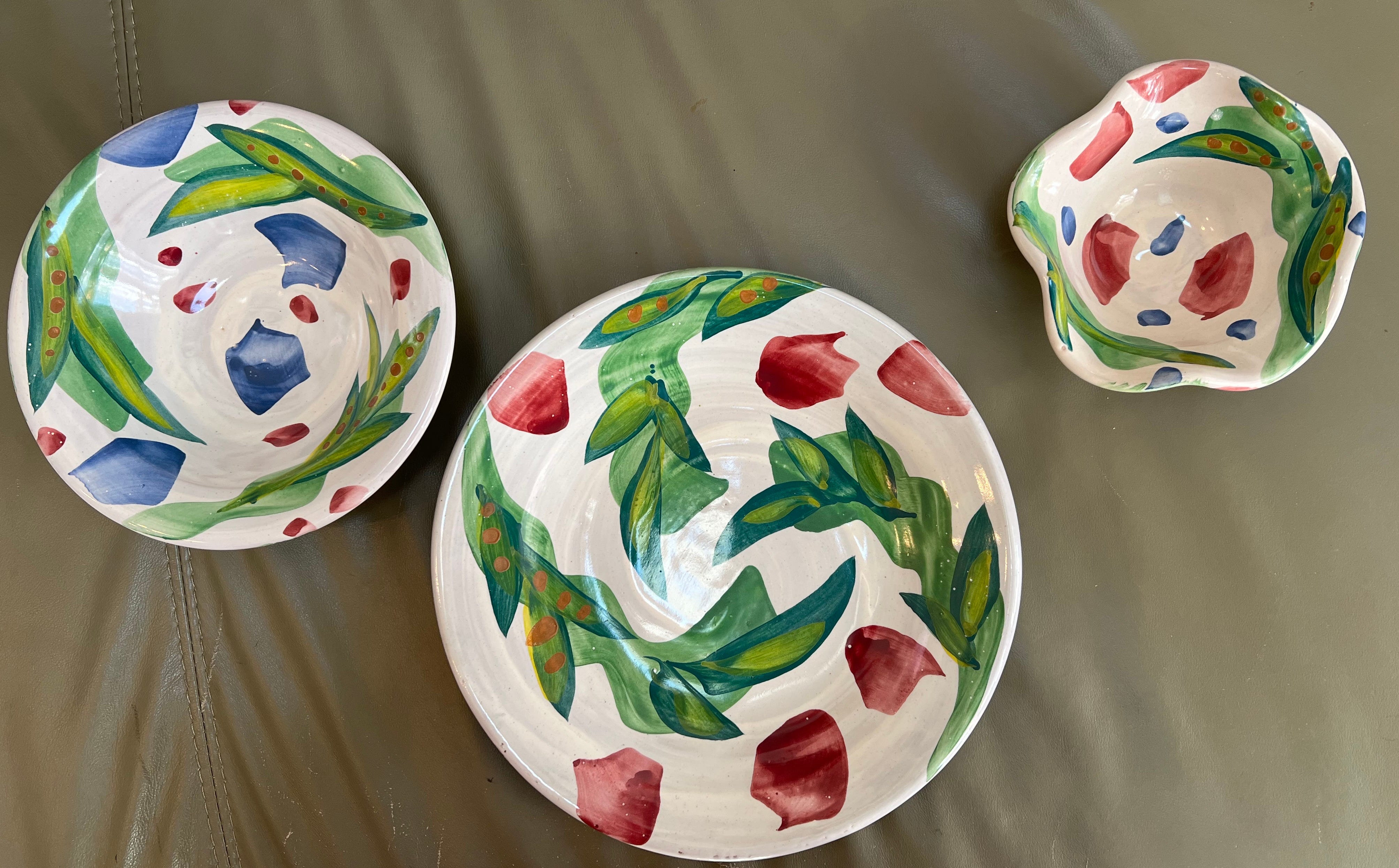
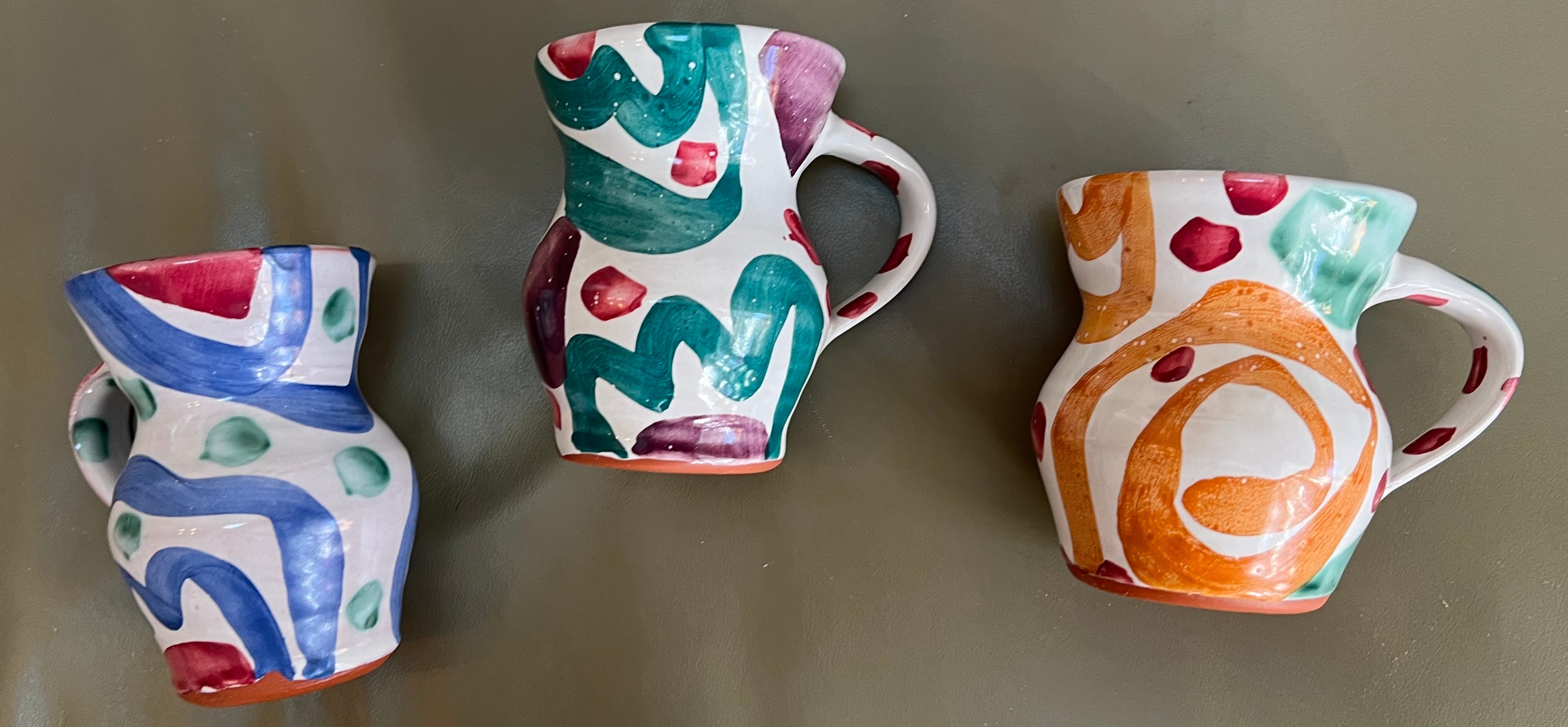
Then there are the whimsical Stanley Anderson plates, mugs, bowls, and servers to which I recently added in order to complete a service for six, knowing that Stan is close to retirement. He grew up in Iowa, studied at the Rhode Island School of Design, became a Penland artist in residence in 1979, and never left the North Carolina mountains. His Majolica-painted earthenware even works alongside my grandmother’s everyday, the Vietri, and the smattering of Fiestaware in the Carrboro cupboard.
Okay, so this is getting downright confessional.
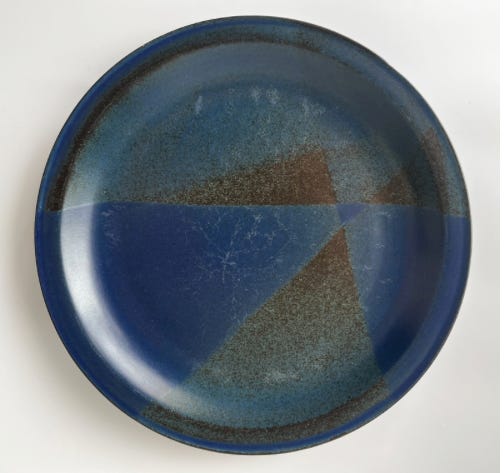
And I am deeply fond of the place settings at the cabin made by Iron Mountain Stoneware, much of which are seconds I was encouraged to take from a dumpster by the owners of the 27-year-old Tennessee pottery that was closing its doors for good in 1992. The founder of that operation, Nancy Patterson Lamb, claimed the inspiration for her hand-dipped glazes came from the deep Appalachian forests that surrounded her in the vicinity of Roan Mountain on the NC/TN border. With the deep blue pattern I have, the glaze rests like layers of fog on a mountain as evening falls.
And then for cabin breakfasts I have the Mountain Ivy pattern from Blue Ridge Southern Potteries. Because the palette of colors used on Blue Ridge pieces are so consistent, it’s possible to mix their many patterns with delight. From 1938 to 1957, this pottery hired an army of women who learned to paint by hand with underglaze to create consistently bright florals and other whimsical designs that were extremely popular and still are. As one collector’s website explains:
“Young ladies, some as young as fifteen, came down from the mountains to be trained as painters at the pottery. Men were taught how to mold the shapes and do the firing. Some of the young ladies were so talented that they were allowed to paint what are called Artists Signed Plates. These are rare, but wonderful to own. Others were content being part of a team who sat in hard chairs around a table and painted for many hours each day. One might paint a flower on the bisque plate while another would add a stem and leaves. A third might paint an edge around the plate and so on until the plate was finished and put in the stack to be fired and glazed.”
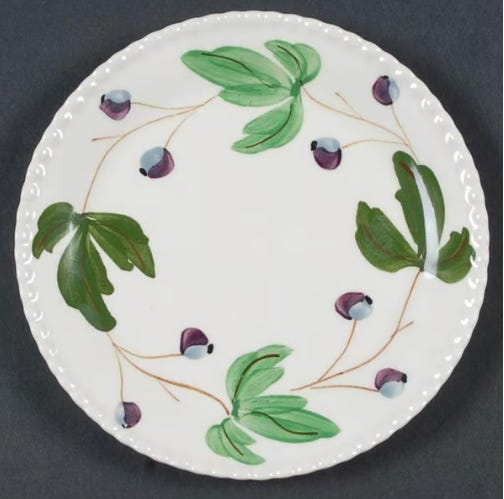
Cheaper imports eventually put Blue Ridge out of business, but the enterprise was an important boost to the economy and to community morale during the Depression and World War II as local women developed skills and a special camaraderie in the production. The business also tapped local assets of kaolinite and feldspar, making the production a true piece of the mountains sent all around the country.
So, collecting table settings is also collecting stories, and I value being able to set my table with the spirits of these makers, along with the family heirlooms. That is why I couldn’t resist ordering the vintage plates on eBay this week because they were designed by Alma Holland Beers (1892-1974), the first woman ever hired to do research in the UNC Botany Department. Beers had taken a summer course in botany at UNC in 1917. (She would not earn her B.A. degree until 1925.)
Beers quickly proved to be a careful laboratory researcher and a talented illustrator of plants. She made herself indispensable to Dr. Williams Chamber Coker, the first chair of the UNC Botany Department. As a woman operating in a male-dominated field and university, it was significant that Alma served as the Executive Director of the Journal of the Elisha Mitchell Scientific Society from 1946 to 1951. Her dinner plate design, created for the historic Carolina Inn in Chapel Hill, features a full moon and the needles, limbs, and cones from the storied longleaf pine, which are synonymous with the North Carolina Sandhills, Beers’s home territory in Moore County. Her story is one among many I am researching for a new book for UNC Press on pioneering women naturalists in the South. Since I can’t sit down to dinner with Alma, at least I can fortify myself with a sandwich on the plate she designed.
Happy Thanksgiving, everyone.
I loved this so much! I will read and re-read anything about plates, their history, their personal meaning. But really, I also will read and re-read anything you write! So, thanks for this.
lovely - and a wonderful thanksgiving gift...